

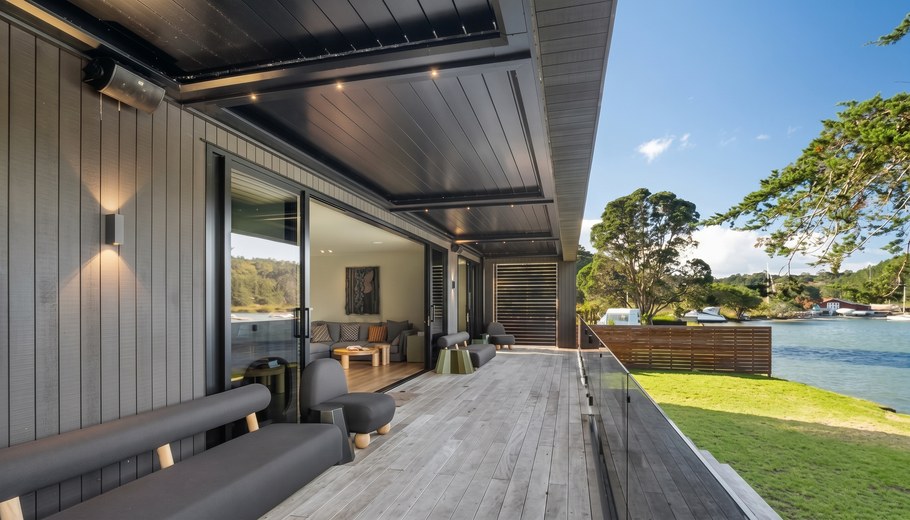
Where does rainwater go when the louvres are closed?
Closed blades interlock to form a continuous roof surface. Each blade has a channel along its length, so water hitting the top is caught and carried sideways to the blade ends instead of dripping through the joins.
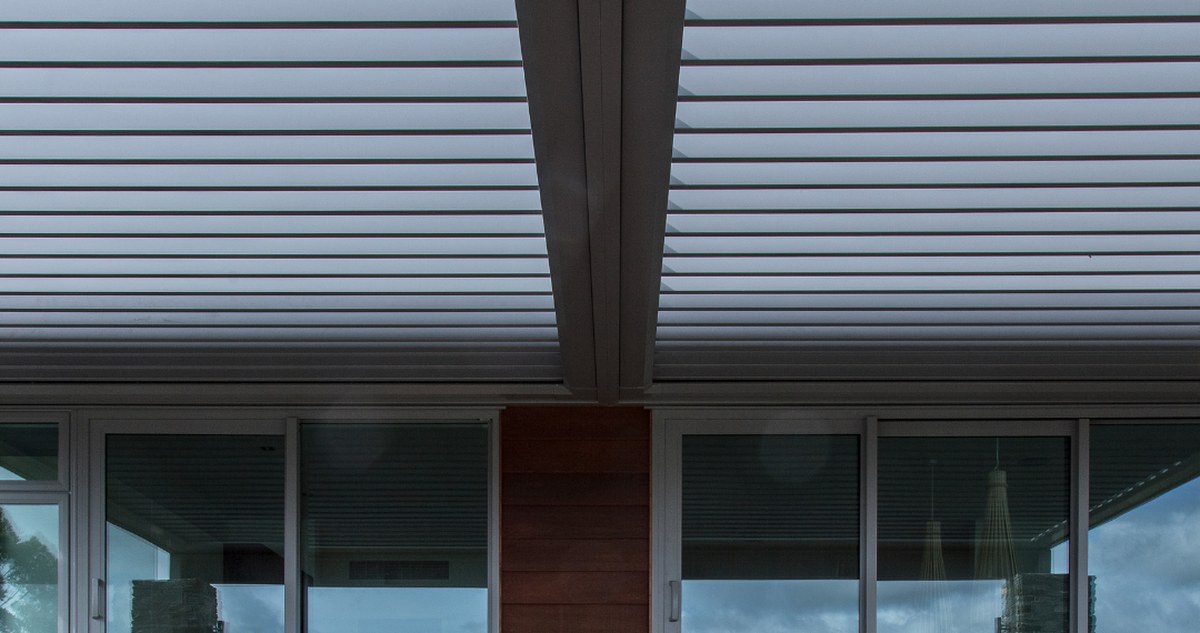
The blade ends sit over a gutter built into the frame beams. That gutter collects runoff from every blade and directs it to an outlet, usually at a corner post, where a downpipe takes over.
Aurae louvre roofs come in two profiles: Aurora, an aerofoil shape, and Solaris, a rectangular blade with a Solaris XL option for larger spans. Both shed water to the perimeter gutters when closed.
If the blades are open when rain starts, water falls straight through. On motorised systems, a rain sensor can close the roof automatically when rain is detected.

How are gutters and downpipes built into a louvre roof?
On a well-designed system, the gutter is part of the frame, so the beams carry both the blades and the water and the roof keeps its clean lines.
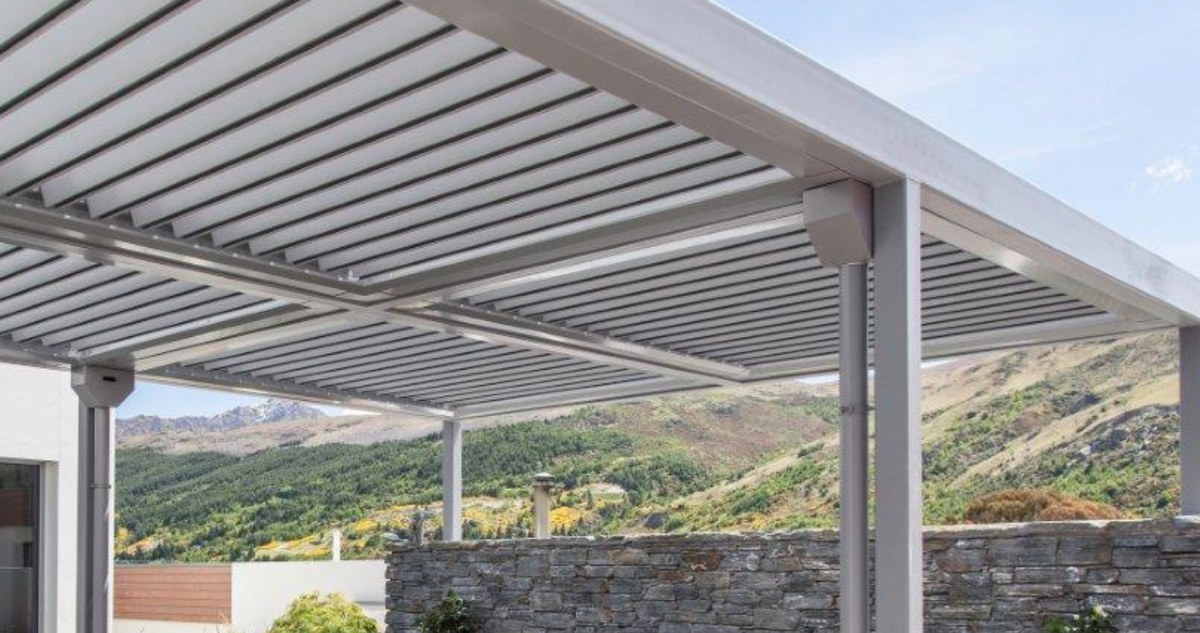
- Internal downpipes: Water runs down inside the support posts, out of sight. Our louvre roof drainage and fixing details include an internal downpipe drainage detail for architects and builders.
- External downpipes: Pipes fixed to the posts or wall, which are easier to reach but more visible.
- Rear-exit drainage: On wall-fixed roofs, water can exit through the back of the frame into the building's own drainage. We have a detail for rear-exit drainage through a timber frame.
- Stormwater or tank connection: Every downpipe needs somewhere to go, whether that's an existing stormwater line, a rainwater tank or a new connection.
A downpipe emptying onto pavers at the base of a post can cause pooling, staining or water running back towards the house, so plan the connection with your builder or plumber early.
Our louvre roofs come with fixing, drainage and electrical details that architects and builders can work from. Explore the Aurae louvre roof range to see how the system fits your plans.
What affects louvre roof drainage in heavy rain?
Australian storms can drop a lot of water in a short burst, and the roof has to clear it as fast as it lands.
Larger roofs send more water to the gutters at once, so they need enough gutter capacity and appropriately positioned downpipes. Our louvre roofs span up to 4.5 metres, subject to wind zone, and larger projects are often split into bays with their own drainage paths.
Rainfall intensity also varies between regions, so downpipe sizing should be calculated for the project location in line with Australian stormwater plumbing requirements under AS/NZS 3500.3.
The drainage system should also be designed around the water falling directly onto the louvre roof. If an adjoining roof discharges additional runoff towards the structure, that extra water needs to be accounted for separately during the drainage design rather than simply being directed into the louvre roof gutter.
Wind matters too. Rain blown sideways can reach under the roof edge on exposed sides, where no gutter can catch it. On coastal or exposed sites, adding fixed louvres or sliding screens on the windward side can help shelter the space. Our article on operable louvre roofs for high-wind coastal homes goes into this in more detail.
Where a wall-fixed roof meets the house, flashing also needs to direct water from the wall into the drainage system. The detail should suit the existing cladding, whether that's brick, weatherboard or another façade system.
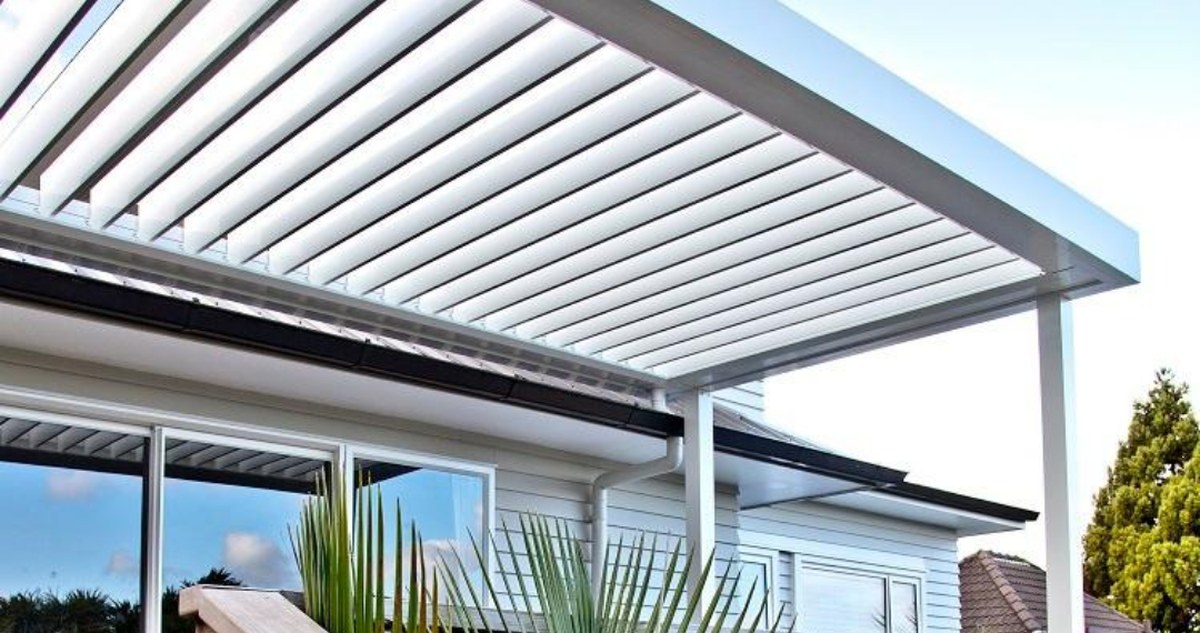
Do louvre roofs leak?
A properly specified and installed louvre roof is designed to provide strong rain protection when closed, directing water through the blades, gutters and downpipes rather than into the covered area.
One of the most common causes of water getting through is overflow: a blocked or undersized gutter that can't clear water fast enough, causing it to spill over the frame edge.
Other problems can include poor flashing at the wall junction, downpipes with nowhere suitable to discharge, or blades left open during rain where no automatic rain control is being used. Leaves or grit in the blade channels can also cause drips at the blade ends during heavy rainfall.
Most of these issues come down to drainage design, installation and maintenance, which makes them easier to prevent when they're considered early.
How do you maintain louvre roof gutters?
A gutter hidden inside the frame is easy to forget, yet it catches everything that lands on the roof. Leaves, pollen and grit build up over time, and a clogged gutter can eventually lead to overflow.
A few times a year, and after major storms, flush the gutters with fresh water and open the blades to check that the channels are clear. Homes near trees may need this more often.
Run water through the downpipes at the same time and check that it drains freely, since internal downpipes can hide blockages until water backs up. On coastal homes, a fresh-water rinse also helps remove salt from sheltered areas.
Always follow the cleaning and maintenance requirements for the selected system and finish, particularly where they form part of the product warranty.
Why plan drainage at the design stage?
Retrofitting drainage is expensive and fiddly. Once posts are up and paving is laid, there's little room to run pipes internally or connect them neatly to stormwater.
Planning early means downpipes can run inside posts, underground pipework can be installed before slabs or paving are completed, and the roof structure can be coordinated around the drainage design.
It also gives architects and builders time to work through gutter capacity, downpipe locations, flashing and stormwater connections alongside the rest of the structure. Our technical resource library includes product specifications, fixing details and other information to support this process.
The best time to sort out drainage is while your plans are still on paper. Make an enquiry and we'll help you design a louvre roof that handles whatever the weather brings.